
Hot tub water
Hot Tub Cloudy After Adding Chemicals? What the Last One You Added Tells You

A hot tub that turns cloudy right after you add something is usually telling you what went wrong. Cloudy after pH up or baking soda almost always means pH or alkalinity overshot, and calcium is coming out of the water as a haze. Cloudy after shock usually means the shock worked and the filter hasn't caught up. Cloudy after a refill points at the fill water. Test first, then fix in order: DipDose aims a hot tub at pH 7.4–7.8, alkalinity 50–80 ppm, and chlorine 3–5 ppm or bromine 4–6 ppm.
In a tub of about 400 gallons, a small overdose moves the water a long way, so the fix starts with a test strip, not another chemical.
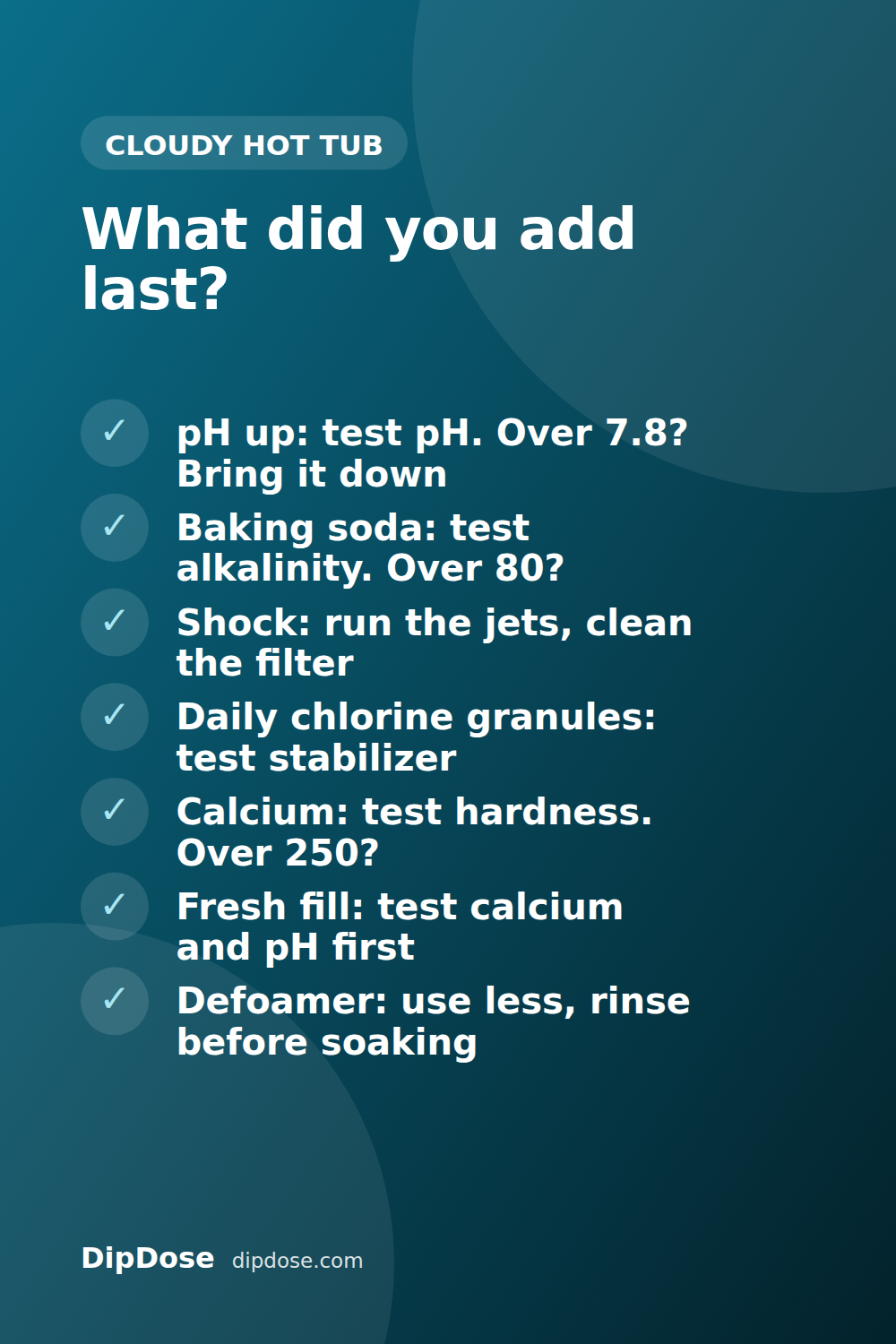
Why is my hot tub cloudy after adding chemicals?
Cloudy water is millions of tiny particles the filter isn't catching. In a hot tub they come from two places. Either something is coming out of the water, like calcium when pH and alkalinity run high, or something is building up in it: oils, lotion, sweat, dead bacteria.
A tub gets there much faster than a pool. It holds a few hundred gallons, so one scoop moves the numbers a long way. The water's hot, and hot water lets go of its calcium more easily. And the jets blow air through it all day, which drives carbon dioxide out and keeps pushing pH up, as DipDose's guide to lowering pH in a hot tub explains.
That's why the last thing you added is the best clue you've got.
| You just added | What's likely happening | Test first, and DipDose's range |
|---|---|---|
| pH up (soda ash) | pH overshot; calcium coming out as haze | pH: 7.4–7.8 |
| Baking soda | Alkalinity high, pH drifting up | Alkalinity: 50–80 ppm |
| Shock or chlorine | Dead particles waiting for the filter | Chlorine 3–5 ppm, or bromine 4–6 ppm |
| Chlorine granules, for weeks | Stabilizer building up | Stabilizer (CYA): 0–30 ppm |
| Calcium increaser | Too much calcium for the pH | Calcium hardness: 100–250 ppm |
| Fresh water | Hard fill water, metals or air | Calcium 100–250 ppm and pH 7.4–7.8 |
Cloudy after adding pH up or baking soda
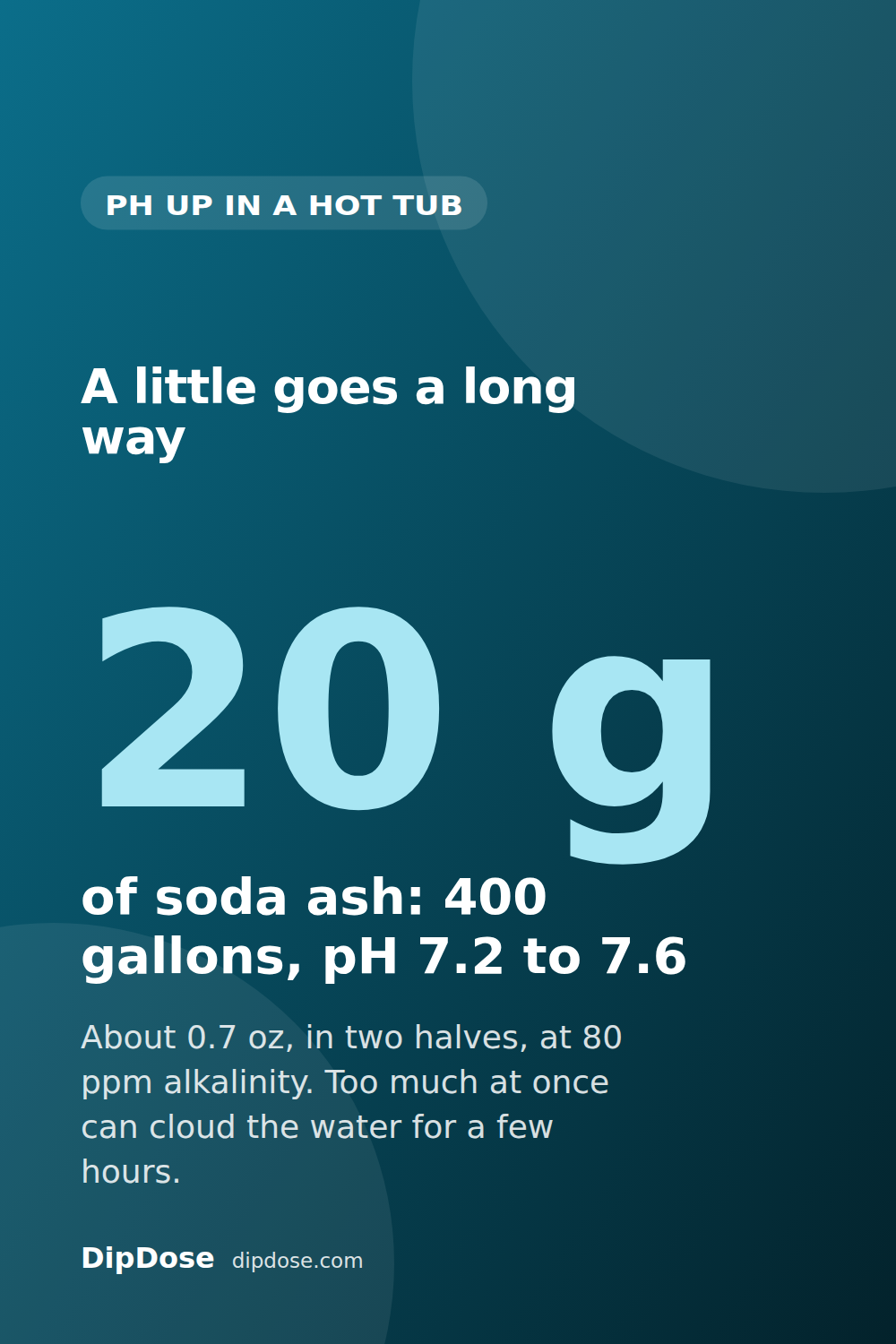
This is the one people hit most, and the cause is simple. pH up is soda ash. It raises pH fast, and in a small tub a little goes a long way: DipDose's calculator gives about 20 grams (0.7 oz) to take a 400-gallon tub from pH 7.2 to 7.6 when alkalinity is 80 ppm. A heaped scoop instead of a measured one can push pH right past 8.
Once pH and alkalinity run high, calcium that was dissolved in the water starts coming out as a fine white haze. DipDose's own note on the soda ash dose says it plainly: "Add it slowly — too much at once can cloud the water for a few hours."
So test pH before anything else. If it's above 7.8, that's your cloud. DipDose's hot tub guide says the same: above 7.8 the sanitizer works poorly, the water can turn cloudy, and scale builds on the heater and jets.
Bring it down with dry acid (spa "pH down"). For the same 400-gallon tub at 80 ppm alkalinity, DipDose gives about 12 grams (0.4 oz) to go from 8.0 to 7.6, and about 16 grams (0.6 oz) from 8.2 to 7.6, in two halves. Dissolve it in a bucket of tub water, then pour it in slowly in front of a jet with the jets running and the cover off. Test again after about 20 minutes and add the second half only if pH is still high.
Acid safety, in DipDose's words
Always add acid to water, never water to acid. Wait at least 30 minutes between acid and chlorine — never mix them. Wear gloves and eye protection when you handle acid.
Baking soda works the other way round. It raises alkalinity far more than pH. If your strip says alkalinity is well over 80 ppm, that's what keeps shoving pH back up, and the haze keeps coming back with it. DipDose's hot tub guide says the same thing: high alkalinity makes pH climb faster, so you end up fixing pH over and over.
Lowering alkalinity is slower. DipDose's dose for 120 down to 80 ppm in 400 gallons is about 5.5 ounces (160 g) of dry acid, in two parts, and it takes a few days: add acid, run the jets with the cover off to lift pH back up, test, and repeat.
Going the other way, if alkalinity is under 50, raise it before you touch pH. About 2 ounces (65 g) of baking soda takes 400 gallons from 40 to 65 ppm. That's roughly ¼ cup plus 1¾ teaspoons, level, though weighing it is better.
Cloudy after shock or chlorine
A tub that clouds over right after a shock is often a good sign. Shock kills what was living in the water and burns off oils and sweat, and the leftovers float until the filter grabs them. DipDose's cloudy pool water guide describes the same thing in a pool, where it usually clears in a day or two. A tub is much smaller, and Water Care Club puts most hot tub haze at 6 to 12 hours after shocking.
Run the jets with the cover off, and pull the filter. If it's slimy or caked, rinse it. A clogged cartridge just pushes the haze around in circles.
If it hasn't cleared by the next day, check two things.
Is the sanitizer still in range?
If chlorine reads under 3 ppm, or bromine under 4, a few hours after the shock, the tub used it all up. Water Care Club's reading of that: an organic load from oils, lotions and sweat too heavy for normal doses, where a drain and refill is often faster than fighting it.
Has stabilizer built up?
Most chlorine granules sold for hot tubs are dichlor, and dichlor brings stabilizer (CYA) in with every dose. DipDose's calculator counts it. A daily top-up from 1 to 4 ppm in 400 gallons is about 8 grams (0.3 oz) and adds about 2.7 ppm of stabilizer. A 1-ounce shock to 10 ppm adds about 9.
DipDose keeps a chlorine hot tub at 30 ppm of stabilizer or less. From zero, that's about 11 daily top-ups. The more stabilizer there is, the more chlorine it takes to do the same job, and it stays until you drain water. That's one reason DipDose's hot tub guide for beginners says to drain, clean and refill every three to four months.
If you shock with cal-hypo instead, it adds calcium as it goes, and DipDose's calculator counts that too. In a tub that's already hazy from hard water, that's the wrong direction. And never put trichlor pool tablets in a hot tub.
Will shock clear up a cloudy hot tub?
Only if low sanitizer was the cause. If the strip shows chlorine under 3 ppm or bromine under 4, shock is the right move. If sanitizer is fine and pH reads 8.2, more shock won't touch it: the haze is calcium, and only bringing pH down fixes it.
Honestly, that's the whole case for testing before you reach for the shock bag. Two cloudy tubs can look the same and need opposite fixes. In a bromine tub, a chlorine shock also turns spent bromide back into bromine, which DipDose's calculator notes when it doses one.
Cloudy after a refill
Why is a hot tub cloudy after you refill it? Usually it's the fill water. Hard tap water can arrive carrying a lot of calcium, and heating it makes that calcium come out. Water Care Club notes that some tap water arrives at 250 ppm or more, which is already the top of DipDose's 100–250 ppm range for a hot tub. Well water can bring metals too: iron turns it brown, copper green or teal.
There's also the harmless kind. Fresh water full of tiny air bubbles looks milky. Fill a clear glass from the tub and set it down. If it clears from the bottom up within a few minutes, it's air, and there's nothing to fix.
On a fresh fill, test before you add anything, so you don't add calcium to water that's already hard. DipDose's order is alkalinity first (50–80 ppm), then pH (7.4–7.8), and calcium only if your water is soft.
Cloudy after calcium or defoamer
Calcium increaser is calcium chloride. In a soft-water tub you need some: DipDose's dose to take 400 gallons from 50 to 150 ppm is about 7.5 ounces (220 g) of 77% calcium chloride. Overshoot past 250 ppm, especially with pH on the high side, and the water turns chalky.
There's no chemical that takes calcium out. The fix is draining part of the water and refilling with softer water, then keeping pH and alkalinity at the low end of their ranges. And handle it with care: "Calcium chloride gets hot as it dissolves — add it to water, never water to it."
Defoamer is a quick fix for foam, and Master Spas warns that using it too often can leave the water cloudy or milky. Foam mostly comes from soap, lotion and conditioner on the people in the tub, so a quick rinse before you get in does more than another capful.
Is it safe to go in a cloudy hot tub?
Not until it's clear. Cloudy water can mean the sanitizer isn't keeping up, and you can't tell which kind of cloudy you've got by looking at it. In a pool, DipDose's rule is to stay out until you can see the floor of the deep end. The same idea works in a tub: wait until you can see the floor and the seats clearly, and your sanitizer tests in range.
The one exception is a fresh fill whose haze is only air: a glass of it clears from the bottom up within a few minutes. Air bubbles are just air.
After you add any chemical, follow the wait on its label before you get in. The product label always wins: if the label and the app disagree, follow the label.
How to clear it, in order
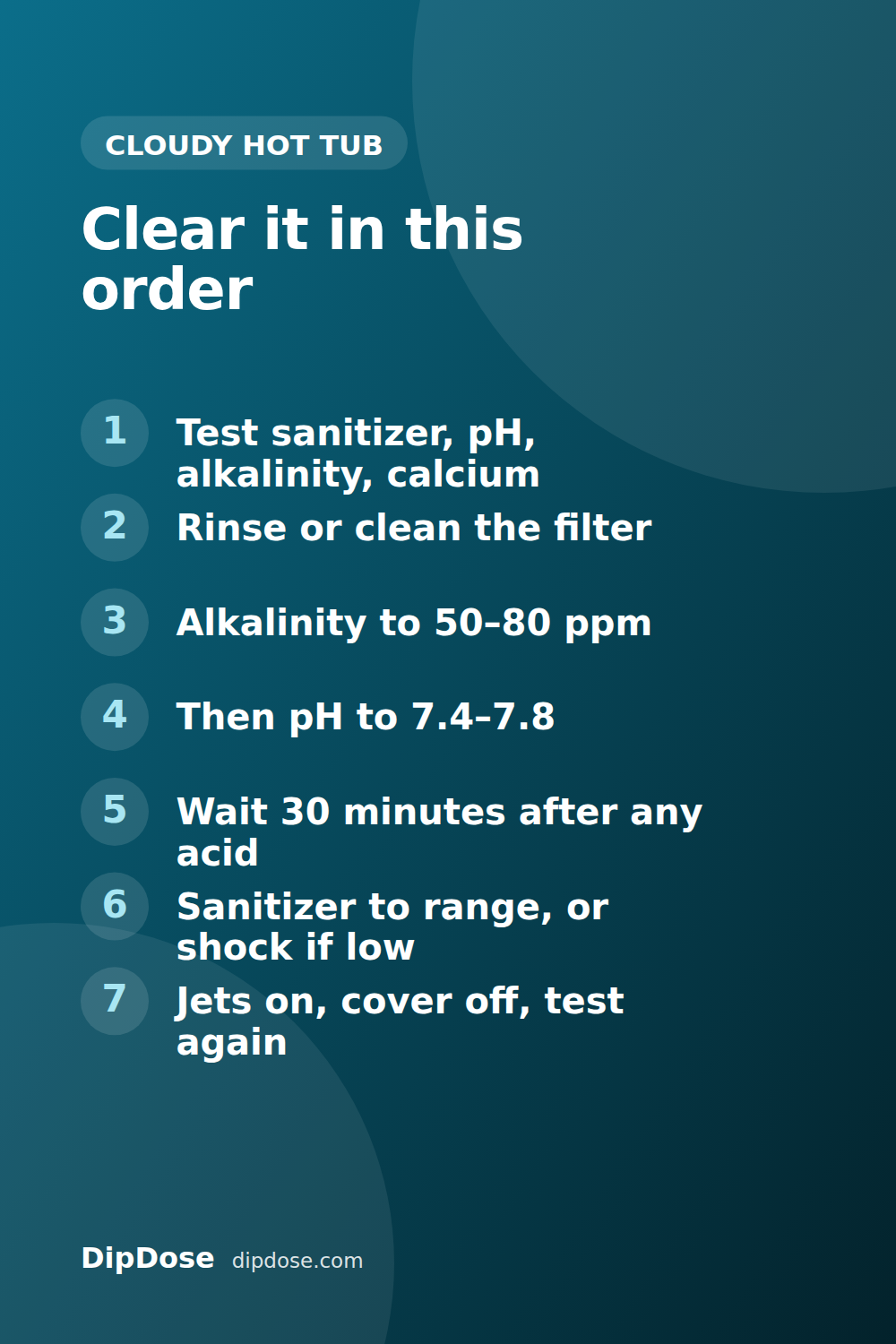
- Test everything you can: chlorine or bromine, pH, alkalinity, and calcium if your kit has it. A strip is fine.
- Clean the filter. Rinse it, or soak it if it's greasy. A tub can't clear through a clogged one.
- Fix alkalinity first, to 50–80 ppm, because it decides where pH settles.
- Then pH, to 7.4–7.8. Small doses, test after about 20 minutes, add more only if you need it.
- Wait at least 30 minutes after acid before any chlorine goes in.
- Then sanitizer: chlorine to 3–5 ppm or bromine to 4–6 ppm. Shock only if it's low.
- Run the jets with the cover off, and test again. Good numbers and still hazy, with water three or four months old? Drain and refill.
One chemical at a time, with the jets running, never mixed outside the water. If you want the amounts done for your own tub's gallons and the products on your shelf, the hot tub calculator does it from your strip's numbers.
Questions people ask
How do you get rid of cloudiness in a hot tub?
Test first, then fix the cause: clean the filter, bring alkalinity to 50–80 ppm, then pH to 7.4–7.8, then sanitizer to 3–5 ppm chlorine or 4–6 ppm bromine. Run the jets with the cover off. If the numbers are good and the water is three or four months old, drain and refill.
Will shock clear up a cloudy hot tub?
Only when low sanitizer is the cause. If chlorine or bromine tests low, shock it and run the jets. If sanitizer is fine and pH is above 7.8, the haze is calcium, and lowering pH clears it, not more shock.
Why is my hot tub water cloudy after I refill it?
Usually hard fill water: calcium comes out as the water heats. Test calcium and pH before adding anything. Milky water that clears from the bottom up in a glass is only air bubbles.
Is it safe to go in a cloudy hot tub?
No. Wait until the water is clear enough to see the floor and the seats, and the sanitizer tests in range. Follow the wait on the label of anything you added.
Sources
- Hot tub chemical calculator (DipDose)
- How to raise pH in a hot tub: 20 g soda ash, 400 gallons, 7.2 to 7.6 (DipDose, read 2026-11-07)
- How to lower pH in a hot tub: 12 g dry acid, 400 gallons, 8.0 to 7.6 (DipDose, read 2026-11-07)
- Hot tub chemicals for beginners: the ranges and the refill schedule (DipDose, read 2026-11-07)
- Cloudy pool water: how to clear it (DipDose, read 2026-11-07)
- Cloudy hot tub water: every cause and how to fix it (Water Care Club, read 2026-11-07)
- Cloudy hot tub water: causes and solutions (Master Spas, read 2026-11-07)