Can You Mix Bromine and Chlorine in a Hot Tub? Shock Yes, Switching No

Yes, a bromine hot tub takes chlorine all the time. No, you can't run bromine and chlorine as two sanitizers side by side, and the two products never meet in a bucket, a scoop or a feeder. The first half surprises people. Chlorine is what turns the bromide left in the water back into working bromine, so a chlorine shock is a normal part of keeping a bromine tub clean. The second half is why the forums argue: both sides are right about different things.
Below is what's safe, what isn't, how much chlorine a 400-gallon bromine tub actually takes, and how to switch from one sanitizer to the other without a mess.
Can you mix bromine and chlorine in a hot tub?
It depends on what you mean by mix. There are three different things people have in mind, and they get three different answers.
- Adding chlorine to a bromine tub as a shock or booster: fine, and expected.
- Running chlorine and bromine together as your two everyday sanitizers: not a plan anyone recommends. You can't tell which one is doing the work, and your test readings stop meaning much.
- Putting the two products together in the dry form: never. Not in one bucket, one scoop, one floating feeder or even side by side on a shelf.
If you read a page that says never mix them and another that says shock with chlorine, they're answering different questions. Go by the product in front of you and the label on it, because the label always wins.
Why chlorine works in a bromine tub

Here's the part that makes the whole thing click. Bromine doesn't just disappear when it kills something. It turns into bromide, a salt that stays dissolved in the water. Add a chlorine product and the chlorine turns that bromide back into working bromine.
So a low bromine reading in a bromine tub is fixed with a chlorine product.
It also explains something odd about the "bromine" granules at the store. They're mostly dichlor, the same chlorine granule hot tub owners use, with roughly 10 to 20 percent sodium bromide mixed in. The chlorine does the quick work, and the bromide is what gets reactivated and keeps the tub going between doses.
So chlorine in a bromine tub isn't a contaminant. It's the lever. The timing is simple: shock first, wait 30 to 45 minutes while the shock does its job and fades, then go back to your bromine as usual.
What should never go together
The safe shock above is chlorine going into the water. The risky versions all happen before anything touches the water. Keep these apart:
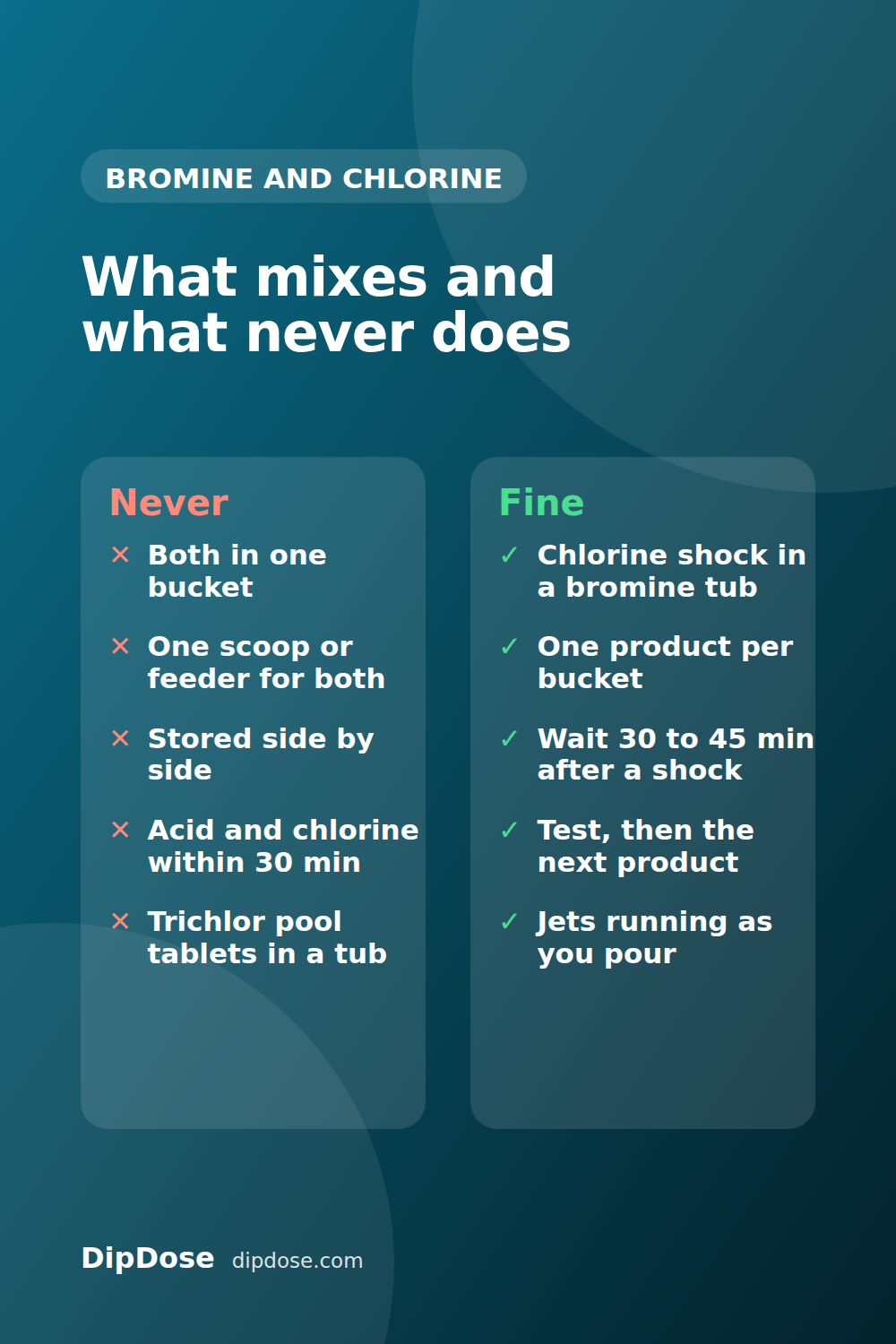
The dry products are the ones to be careful with. Never mix them dry, especially the granules. Don't store them next to each other even in sealed containers, and don't use one feeder for both, because leftover residue can react with the next chemical. Mixing the two products can also give off heat, which is one more reason to keep them on different shelves.
Acid and chlorine is the other pair to keep apart. DipDose's own rule is to wait at least 30 minutes between acid and chlorine and never mix them. Add acid to water, never water to acid, and pour slowly in front of a return jet with the pump running.
One more, from DipDose's hot tub beginner page: never put trichlor pool tablets in a hot tub. Hot tub doses are tiny, so use hot tub amounts.
How much chlorine does a bromine tub take?
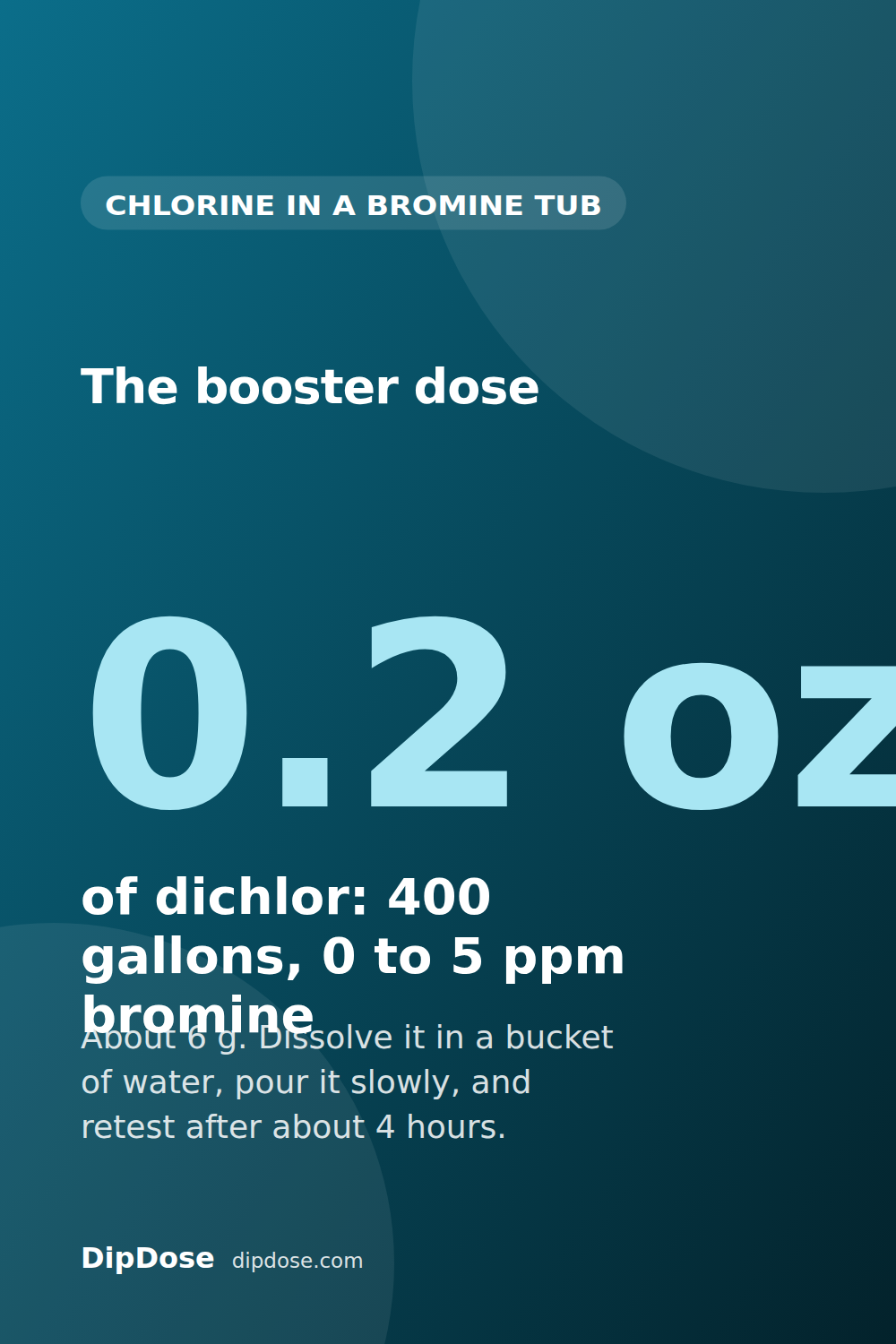
Not much. A hot tub holds a few hundred gallons, so the doses are small, often a spoonful or less. The amount depends on the tub's gallons, your reading and the product, and the aim is 5 ppm of bromine, the middle of the 4 to 6 ppm range for a bromine tub.
Here's what dichlor granules (56%) come to by tub size. A tub that has dipped to 2 ppm of bromine takes about 3 g at 300 gallons, 3.6 g at 400 and 4.5 g at 500, and a tub reading zero takes about 4.5, 6 and 7.5 g.
| Tub size | From 2 ppm | From 0 ppm |
|---|---|---|
| 300 gallons | 0.1 oz (about 3 g) | 0.2 oz (about 4.5 g) |
| 400 gallons | 0.1 oz (about 3.6 g) | 0.2 oz (about 6 g) |
| 500 gallons | 0.2 oz (about 4.5 g) | 0.3 oz (about 7.5 g) |
If you keep liquid chlorine around instead, the same 400-gallon tub from 2 ppm takes 0.5 fl oz of 12.5% liquid chlorine, which is about 1 tablespoon plus a quarter teaspoon. Pour it slowly in front of a return jet with the pump running, and dissolve granules in a bucket of water first.
Two small side effects are worth knowing about. Each dichlor dose from 2 ppm adds about 1.2 ppm of stabilizer to a 400-gallon tub, and a liquid chlorine dose adds about 2.2 ppm of salt. That's tiny once, and it adds up if you top up every week for months, which is one more reason to drain every three to four months.
If the label on your bag gives a different amount, follow the bag.
Why a test strip says chlorine in a bromine tub
This one catches a lot of people. The common test reagents react to bromine as well as chlorine, so a bromine tub can show up as "chlorine" on a strip or kit built for chlorine. On those tests, free bromine registers as free chlorine.
The numbers are different, though. A reading of 1 ppm on the chlorine scale is 2.25 ppm of bromine, so the same colour means more bromine than it would chlorine. That's why a bromine tub that reads 2 on a chlorine pad is actually sitting around 4.5 ppm of bromine, right where you want it.
If your strip has a separate bromine pad, use it. If it doesn't, check the scale on the bottle before you add anything, so you know which units you're reading.
Honestly, this is the most common reason people think a bromine tub is low when it's fine. Test two or three times a week, and again before a soak if the tub has sat unused.
Switching from bromine to chlorine
This is where mixing does cause trouble. Because chlorine keeps reactivating the leftover bromide, you can't just stop adding bromine and start adding chlorine and call it done. The bromide stays in the water and the tub acts like a bromine tub for a long time.
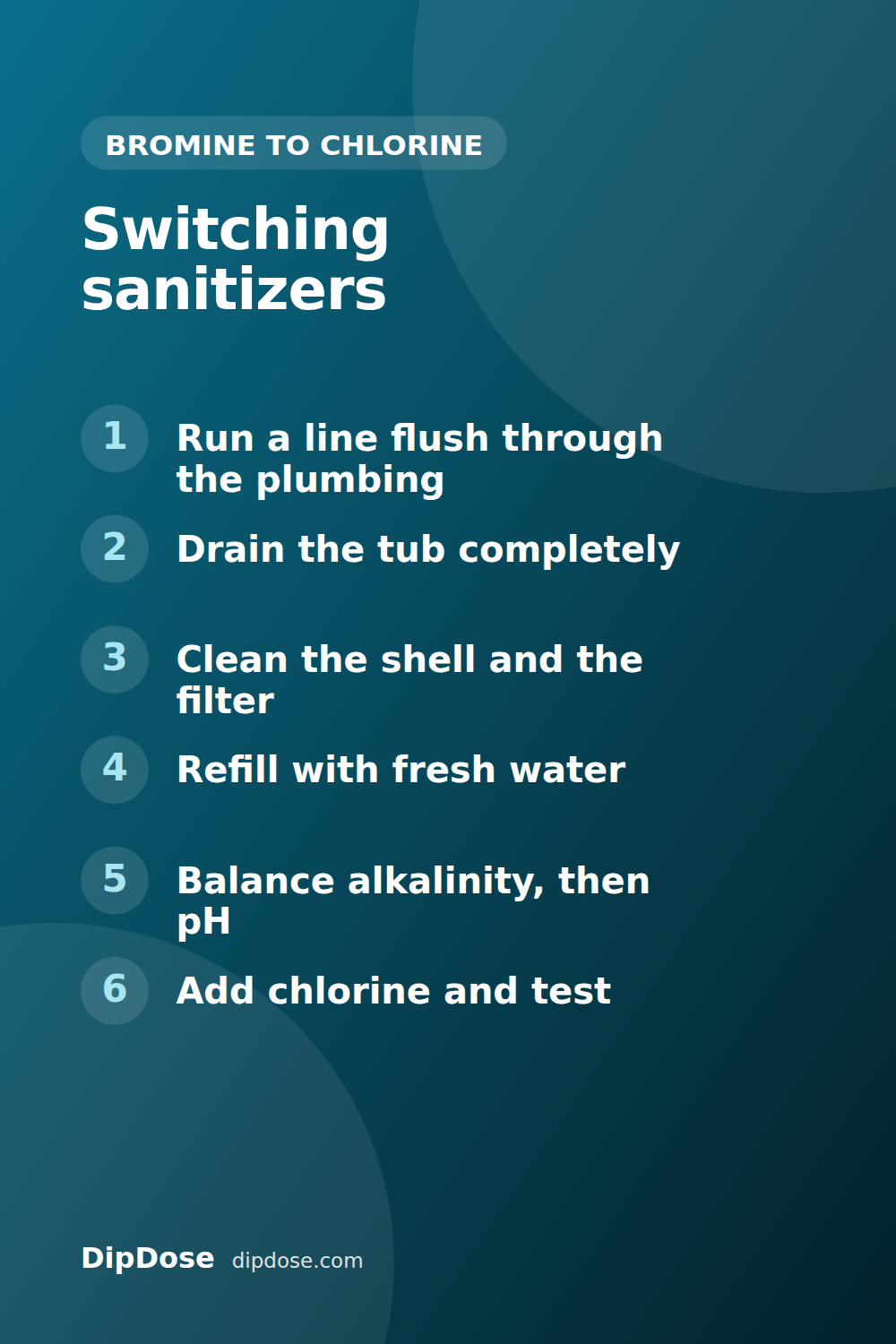
The fix is to drain the tub, clean it and flush the lines, then fill with fresh water and start the new sanitizer. It also helps to run a pipe degreaser through the plumbing before you empty it, because bromine can leave a residue on the shell and inside the pipes.
Go the other way, from chlorine to bromine, with the same routine. Pick one and stay with it. Flipping back and forth costs you a drain every time, plus the chemicals to rebalance.
Once it's refilled, set alkalinity first and pH second: 50 to 80 ppm for alkalinity, then 7.4 to 7.8 for pH. Then start the sanitizer you picked; the hot tub chemical calculator has the doses for your gallons.
What if you already mixed them?
It happens. A floater that held bromine got a scoop of chlorine, or a bucket got reused. Don't panic and don't add anything else.
- Stop adding either product and take the floater out of the water.
- Keep the jets running so what's in there spreads out.
- Test again in a few hours.
- If the label or your spa's manual says to drain, drain.
And if the tub's water itself just has both in it, a bromine tub that got some chlorine, that's not an emergency. That's exactly what a chlorine booster does.
Is bromine or chlorine better for a hot tub?
Neither wins everywhere. Bromine holds up better in hot water and smells less, and chlorine works faster and costs less. Pick one and stay with it.
Bromine does cost more, and it takes a larger dose than chlorine for the same sanitizing. You don't have to add it as often, though, so the cost can come out about equal. It also breaks down in UV light, which matters if your tub has a built-in UV system, and it's harder to bring back if you skip a few shocks.
For a first tub, the easy choice is the one your spa dealer sells the tablets for, because then the floater, the dose and the advice all match. Whichever you choose, test two or three times a week, keep the pH at 7.4 to 7.8, and shock after heavy use or once a week.
Questions people ask
What happens when chlorine is mixed with bromine?
In the water of a bromine tub, chlorine turns the bromide back into working bromine, which is why a chlorine shock is normal. In the dry form, the two products should never share a bucket, scoop or feeder, because leftover residue can react.
Can I shock my hot tub if I use bromine?
Yes. A chlorine shock works in a bromine tub, and so does a non-chlorine shock. Wait 30 to 45 minutes after a chlorine shock before you go back to bromine, and follow the label for how long to wait before a soak.
What should you not mix bromine with?
Never mix it dry with chlorine, and never use the same scoop, bucket or feeder for both. Keep acid and chlorine at least 30 minutes apart, and never put trichlor pool tablets in a hot tub.
Can you switch a hot tub from bromine to chlorine?
Yes, but drain it first. Clean the shell and filter, flush the lines, refill with fresh water and then start the new sanitizer, because the bromide left in the old water will turn back into bromine every time you add chlorine.
Sources
- Hot tub chemical calculator: ranges and doses (DipDose, read 2026-11-27)
- Hot tub chemicals for beginners (DipDose, read 2026-11-27)
- Bromine vs. chlorine: how to choose a hot tub sanitizer (Swim University, read 2026-11-27)
- Chlorine or bromine for a spa: common questions (Spaworld, read 2026-11-27)
- Can you mix bromine and chlorine in a hot tub? (Cristallo Pools, read 2026-11-27)
Keep reading
Hot Tub Cloudy After Adding Chemicals? What the Last One You Added Tells You
Hot tub cloudy after adding chemicals? The last one you added points to the cause: pH up, baking soda, shock, calcium or a refill. What to test and fix.
Hot Tub Water Green? Clear Green and Cloudy Green Need Different Fixes
Hot tub water green? Clear green with smooth walls is usually metal; cloudy green with slimy walls is algae. How to tell, and the doses for a 400-gallon tub.